
In the fast-accelerating world of artificial intelligence, businesses and developers must ace the differences between leading models like Claude, GPT, and open-source alternatives to navigate in 2026’s AI model landscape. This stark comparison reveals their core capabilities, advantages, and trade-offs.
The Rise of AI Language Models
AI language models have moved from research labs into everyday workflows, powering chatbots, content engines, analytics, and internal tools. Demand has surged as companies realize that smarter models can boost productivity, reduce errors, and unlock new customer experiences.
Among the leaders, Claude, GPT, and a growing roster of open‑source models (like DeepSeek, Llama‑4, and others) now anchor this transformation. Each brings a different philosophy:
- Claude emphasizes safety, alignment, and reasoning.
- GPT focuses on versatility, breadth, and ecosystem integration.
- Open‑source models prioritize customization, transparency, and cost control.
Users often note subtle but important differences. For example, Claude frequently explains why it refuses a request, while GPT tends to fall back on more generic refusal messages. That transparency can matter a lot in regulated, ethical, or customer‑facing workflows.
Claude: Safety, Reasoning, and Empathy
Claude, developed by Anthropic, is built around Constitutional AI—a framework that continuously steers the model toward being helpful, honest, and harmless. It’s trained with constraints that make it less likely to hallucinate, produce harmful outputs, or ignore its own safety guidelines.
Key strengths in 2026:
- Strong structured reasoning and coding reliability, performing well on benchmarks like SWE‑bench (around 80%+).
- High accuracy in complex, nuanced queries, especially in areas like legal, financial, or mental‑health‑adjacent support.imaginovation+1
- Emphasis on contextual continuity and empathy, making it a favorite for customer‑facing or emotionally sensitive interactions.
Claude’s base subscriptions often sit around $20/month, targeting teams that prioritize ethical, safe, and consistent outputs over lowest cost.
GPT: Versatility, Integration, and Agentic Power
OpenAI’s GPT‑4/5‑series (including variants like GPT‑5.2–5.4) remains the benchmark for flexibility. These models are trained using Reinforcement Learning from Human Feedback (RLHF), where human reviewers rank responses to shape the model’s behavior and preferences.
What sets GPT apart in 2026:
- Multimodal capabilities: handling text, images, and structured data in a single pipeline, making it ideal for creative workflows, UI‑assisted coding, and content pipelines.
- Deep ecosystem integration: tools like ChatGPT Enterprise, API‑based agents, and plugins into productivity suites (Notion, Slack, etc.) let teams embed AI directly into existing workflows.
- Strong general‑purpose performance, with high scores on public benchmarks (e.g., ~80% on SWE‑bench and top‑tier rankings on Chatbot Arena).
GPT typically starts at $15/month on standard plans, balancing power and price for teams that want plug‑and‑play AI rather than heavily customized models.
Open‑Source AI: Flexibility, Cost, and Community
Open‑source models like DeepSeek V3, Llama‑4, GLM‑5, and others are reshaping how organizations think about AI. They democratize access, enabling teams to inspect, modify, and fine‑tune models without vendor lock‑in.These models are often hosted on platforms like GitHub and Hugging Face, with ready‑made libraries for NLP, vision, and agent frameworks. For small teams or startups, this means:
- Building custom chatbots, analytics engines, or specialized tools without paying per‑token to a big vendor.
- Fine‑tuning on domain‑specific data (e.g., marketing copy, legal docs, medical records) for highly tailored behavior.
- Lower upfront costs (often free to download) though some hosting and engineering overhead remains.
Recent benchmarks show that open‑source leaders like GLM‑5 and DeepSeek V3 now sit within 5–10 percentage points of top proprietary models on coding, math, and general reasoning—while matching or beating them on some core metrics.venasolutions+1
Guide to Choose: A 2026 Decision Framework
Selecting the right model in 2026 comes down to four key axes:
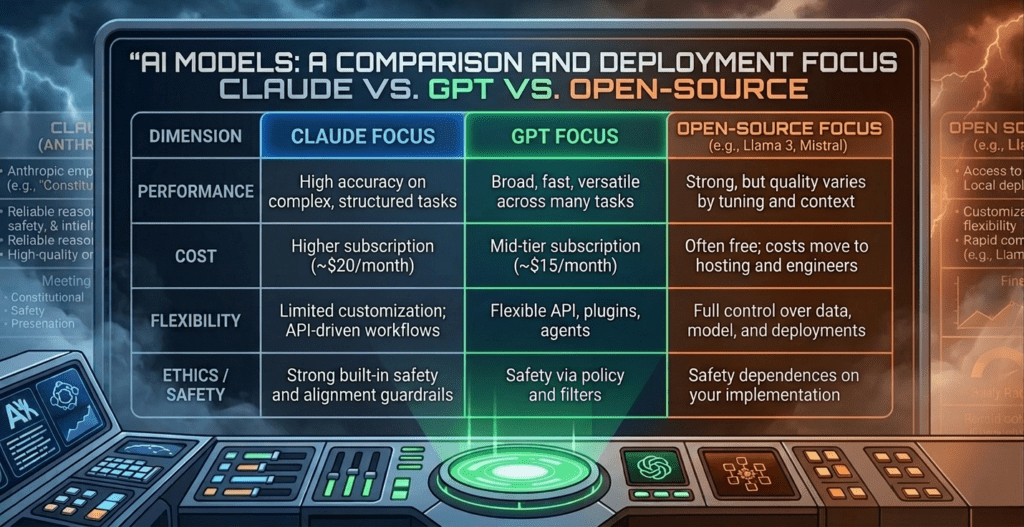
For regulated marketing, economic research, or compliance‑heavy work, Claude and GPT are often preferred due to their low hallucination rates and strong guardrails.
For experimental, niche, or low‑budget projects, open‑source models let teams iterate fast and keep full control over their stack.
Real‑World Examples from 2026
Several industries are already combining these models in hybrid stacks:
- Healthcare: A telehealth provider used Claude to handle patient‑facing queries, achieving ~30% faster response times and higher satisfaction scores thanks to its empathetic, error‑aware behavior.zoetalentsolutions+1
- E‑commerce: A mid‑sized brand leveraged GPT‑5.4 to power product‑recommendation emails, cutting human workload by ~40% while maintaining high click‑through rates.businessdasher+1
- Education: A literacy NGO built an interactive app on an open‑source model, tailoring content for children and teachers—showing how community‑driven models can scale without enterprise price tags.imaginovation+1
Case studies like these highlight a growing trend: hybrid architectures where companies use Claude for high‑stake, sensitive interactions, GPT for broad‑scale engagement, and open‑source models for niche or experimental use cases.
Projected Trends and Market Growth
The broader AI landscape is expanding rapidly. By 2026, analysts project that over 75% of enterprises will integrate AI into core operations, with customer service, marketing, and analytics leading adoption. The global AI market is on track to approach around $1 trillion by 2028, driven largely by language and multimodal models.venasolutions+1
Key trends shaping the next few years:
- Stronger emphasis on ethical and aligned AI, following Claude’s Constitutional AI playbook.
- Hybrid stacks blending proprietary performance with open‑source customizability.
- Tighter regulations around transparency, bias, and data usage, pushing teams to audit and document which models they use.
How to Decide for Your Business
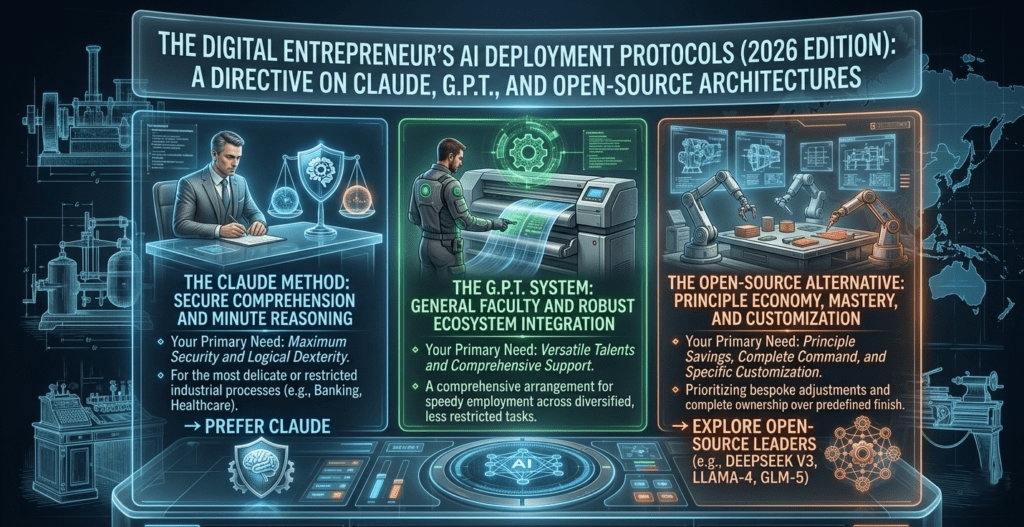
If you’re evaluating which model to adopt in 2026, ask:
- Do you need maximum safety and reasoning for sensitive or regulated work? → favor Claude.
- Do you want broad capabilities and strong ecosystem integration with minimal setup? → lean toward GPT.
- Do you care more about total cost, control, and customization than out‑of‑the‑box polish? → explore open‑source leaders like DeepSeek V3, Llama‑4, or GLM‑5.
A practical next step is to run small pilots using trials or short‑term subscriptions, then compare performance, cost, and developer experience across your most critical workflows.
By understanding Claude, GPT, and open‑source AI models not as substitutes but as complementary tools, you can build a future‑proof AI strategy that balances power, ethics, and cost in 2026 and beyond.