
Enterprise AI is no longer a pilot project buried in the IT department. It is a full-scale business transformation happening right now, across every industry, every function, and every level of leadership. The question executives are no longer asking is “Should we adopt AI?” — they’re asking “Which enterprise AI platform is the right one for us?” That distinction matters enormously. Choosing the wrong platform wastes millions. Choosing the right one compounds your competitive advantage every single quarter. This guide cuts through the noise and gives you exactly what you need to make that call.
Top 10 Enterprise AI Platforms You Should Know in 2026
1. Microsoft Azure AI + Copilot Studio / Microsoft 365 Copilot
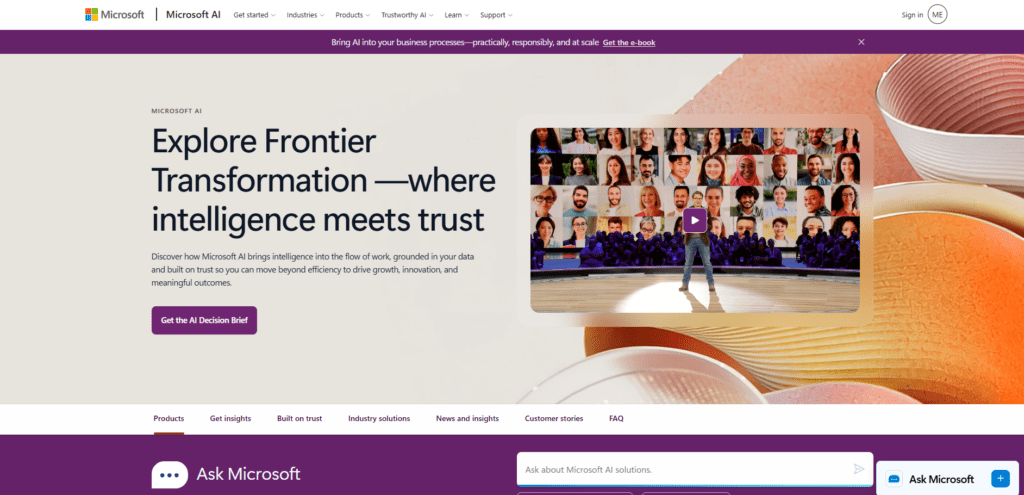
For most large organisations, Microsoft is the default starting point — and for good reason.
If your enterprise runs on Teams, Outlook, Excel, Power Platform, or Dynamics, Microsoft’s AI ecosystem slots in without friction. Copilot Studio enables low-code agent building that non-technical teams can actually use. Microsoft 365 Copilot brings AI directly into the tools your knowledge workers already use every day, reducing the adoption barrier to near zero.
What makes Microsoft the dominant choice is its combination of breadth and governance. Microsoft Graph connects AI to your organisational data in a secure, compliant way. Enterprise governance is built in — not bolted on. For organisations that need fast, broad internal adoption with measurable productivity gains, Microsoft consistently delivers the fastest time-to-value of any platform on this list.
Best for: Knowledge workers, broad internal adoption, organisations already in the Microsoft ecosystem.
Link: https://www.microsoft.com/en-us/ai
2. Google Cloud Vertex AI (with Agent Builder & Gemini)
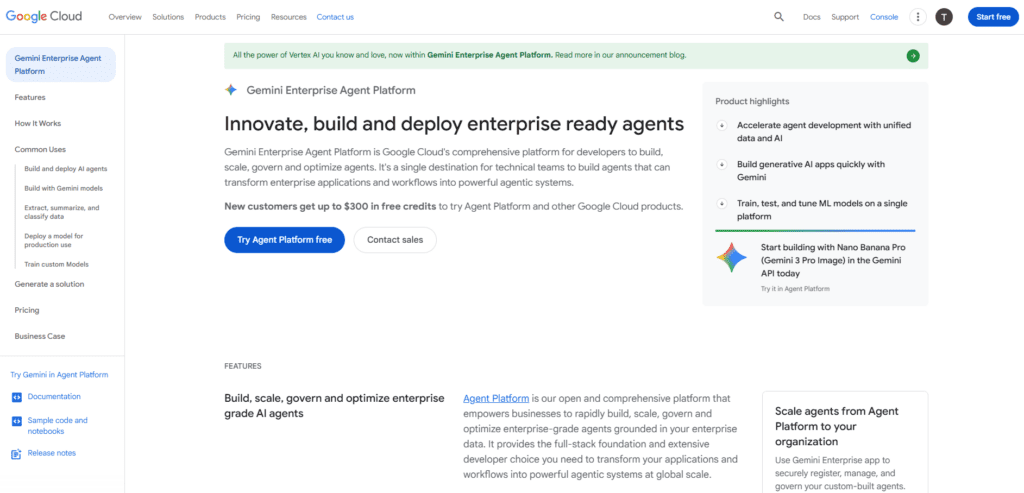
Google’s enterprise AI solution is designed especially for businesses that approach data seriously.
Vertex AI is great at custom model training, multimodal capabilities (meaning it can handle text, images, audio, and video in one controlled environment), and end-to-end MLOps. Among the most well-known tools available for creating production-ready AI agents that are scalable, auditable, and enterprise-grade is the Vertex AI Agent Builder.
Google’s foundational model, Gemini, adds multimodal intelligence and strong reasoning skills to the platform. For companies that focus on innovation and already use Google Cloud or Google Workspace, this is an obvious and great option. Analysts routinely rank Vertex AI among the greatest systems for both execution and invention.
Best for: Organizations that rely heavily on data, teams that are driven by innovation, and businesses that use Google Cloud infrastructure.
Link: https://cloud.google.com/vertex-ai
3. AWS Bedrock + SageMaker + AgentCore
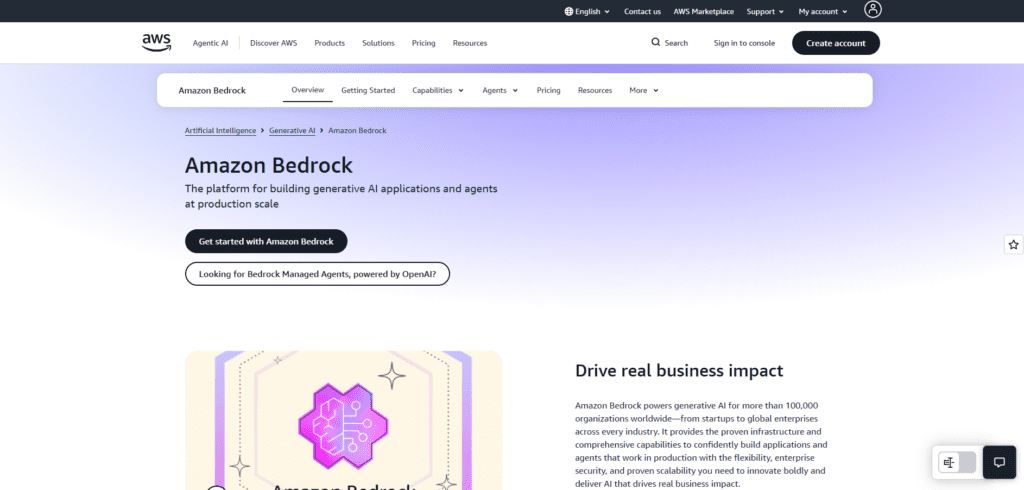
Amazon Web Services provides the most flexibility, something that no single-vendor platform can equal.
Within one safe environment, AWS Bedrock provides businesses with access to a variety of foundation models, including third-party models from Anthropic, Meta, and others. SageMaker manages large-scale custom model training and deployment. Building and running AI agents in production is robustly orchestrated by AgentCore.
This stack is unrivaled for cloud-native businesses requiring cost optimization, a wide range of models, and seamless integration with their current AWS ecosystem. It is especially effective in infrastructure-intensive workloads where control, customisation, and cost management are absolutely essential priorities.
Best for: Cloud-native businesses, companies requiring multi-model versatility, and workloads heavy on infrastructure.
Link: https://aws.amazon.com/bedrock/
4. Databricks Mosaic AI
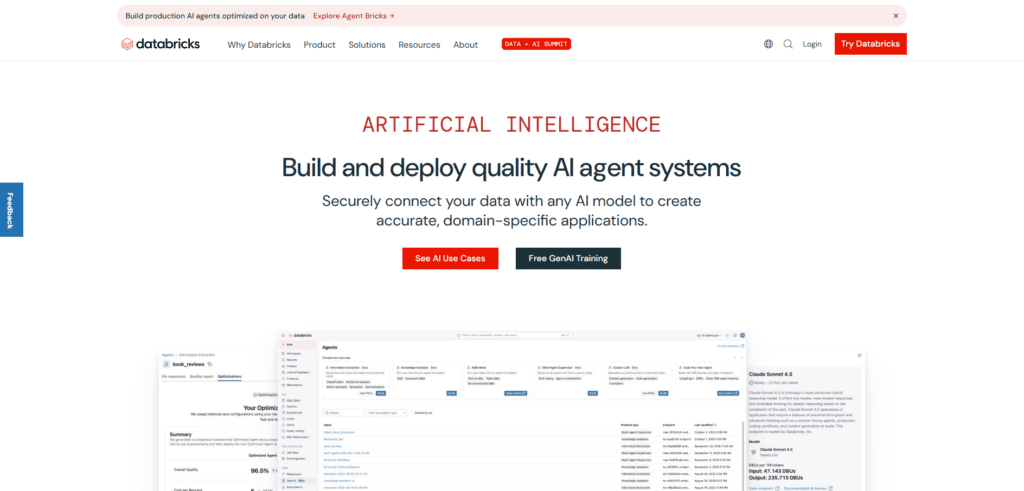
Databricks is made for you if your competitive edge comes from your data.
For companies with enormous datasets and lakehouse designs, Mosaic AI is the go-to tool. It integrates vector search, custom model fine-tuning, data engineering, and agent frameworks, all while maintaining AI operations near your data, which is where they should be. Strong alliances with OpenAI and Anthropic enable you to use top-notch foundation models without giving up data control.
Databricks provides a depth of integration few rivals can equal for businesses where analytics and generative AI must coexist on the same platform under combined governance across both.
Ideal for: Data-intensive businesses, analytics-first companies, lakehouse architecture settings.
Link: https://www.databricks.com/product/machine-learning
5. IBM watsonx
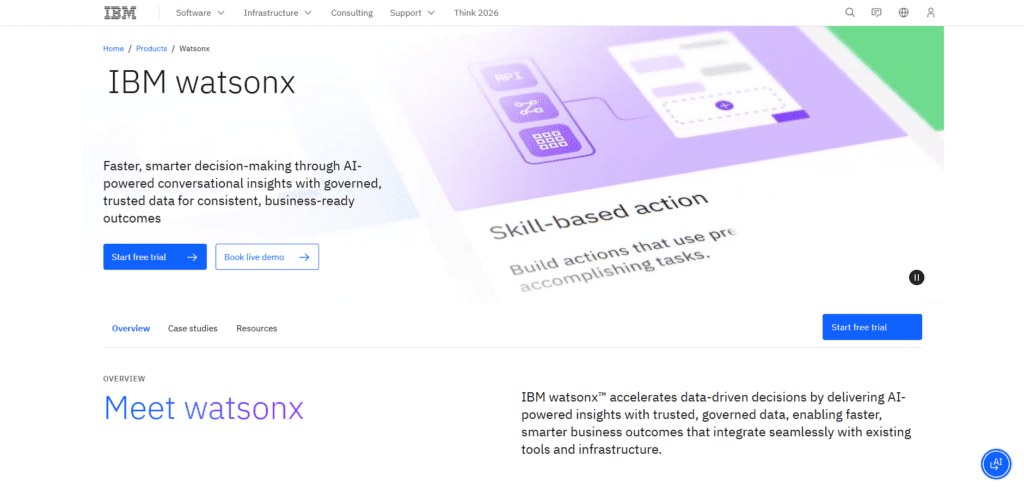
Trust is not discretionary in regulated sectors. It forms the basis of IBM watsonx.
Watsonx takes the lead in hybrid and multi-cloud support, governance, explainability, and model lifecycle management. watsonx gives the framework to run with confidence for executives in financial services, healthcare, and government, where AI decisions have to be auditable, clear, and defensible.
Watsonx Orchestrate provides compliant agentic workflows satisfying the highest regulatory standards. IBM watsonx is the platform for you if your main priorities are risk management, dependability, and responsibility.
Ideal for: Finance, healthcare, government, and any controlled sector whereby auditability is essential.
Link: https://www.ibm.com/watsonx
6. Salesforce Agentforce (with Einstein 1 & Data Cloud)
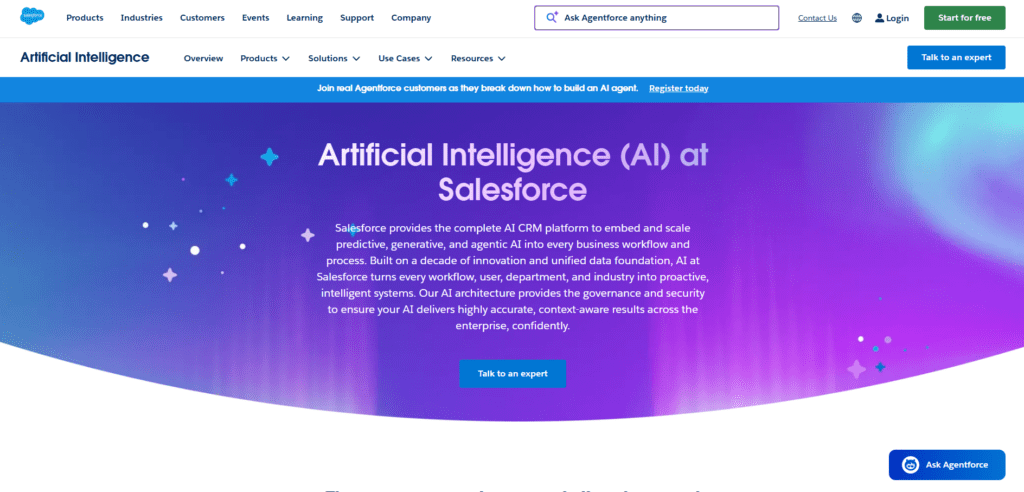
Salesforce Agentforce is the platform that provides direct support where it counts for companies where revenue and customer relationships define the business.
Deeply integrated into CRM, sales, service, and marketing workflows, Agentforce powers autonomous AI agents that manage customer-facing operations with robust personalization and quantifiable revenue influence. While Data Cloud links customer data throughout every touchpoint to power more intelligent, contextual AI interactions, Einstein 1 unifies the platform.
This is enterprise conversational artificial intelligence at the front-office level, where every encounter presents a chance to either strengthen a customer connection or seal a transaction. Salesforce is the perfect natural and strong match for businesses in which front-office automation and customer data define value.
Best for: Revenue teams, CRM-heavy operations, sales-led, and customer-centric companies.
Link: https://www.salesforce.com/artificial-intelligence
7. ServiceNow Now Assist / Now Platform AI
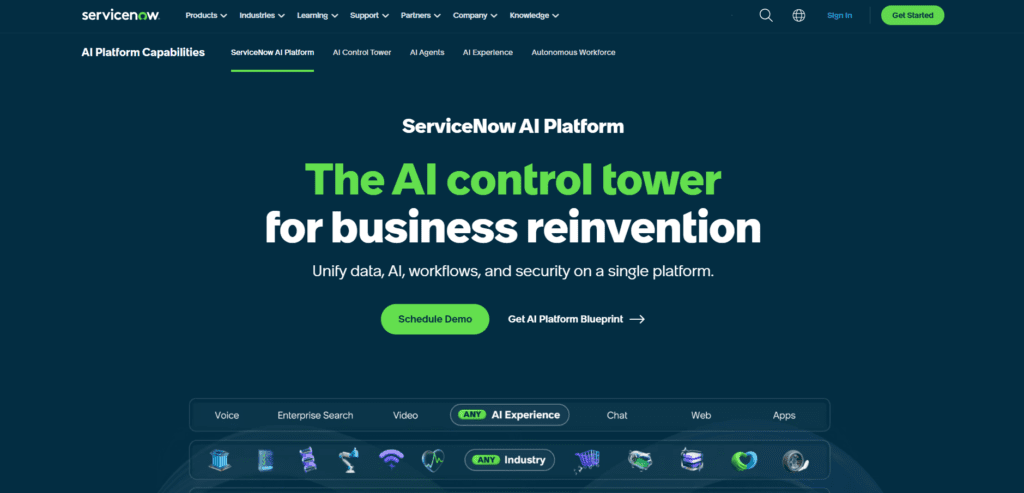
Quietly, internal operations have seen ServiceNow become among the most significant corporate conversational AI systems.
In IT service management, HR processes, ticketing systems, and employee experience, sections that require significant operational expense in big firms, Now Assist integrates generative artificial intelligence and intelligent agents. Faster resolution times, less manual work, and a demonstrably improved employee experience are the outcomes.
ServiceNow’s process orchestration capabilities are among the best in the market for executives concentrating on operational efficiency and internal service delivery. For any company trying to update internal work processes, it is extremely effective.
Best for: IT service management, HR automation, enterprise operations, internal efficiency.
Link: https://www.servicenow.com/platform.html
8. Snowflake Cortex AI
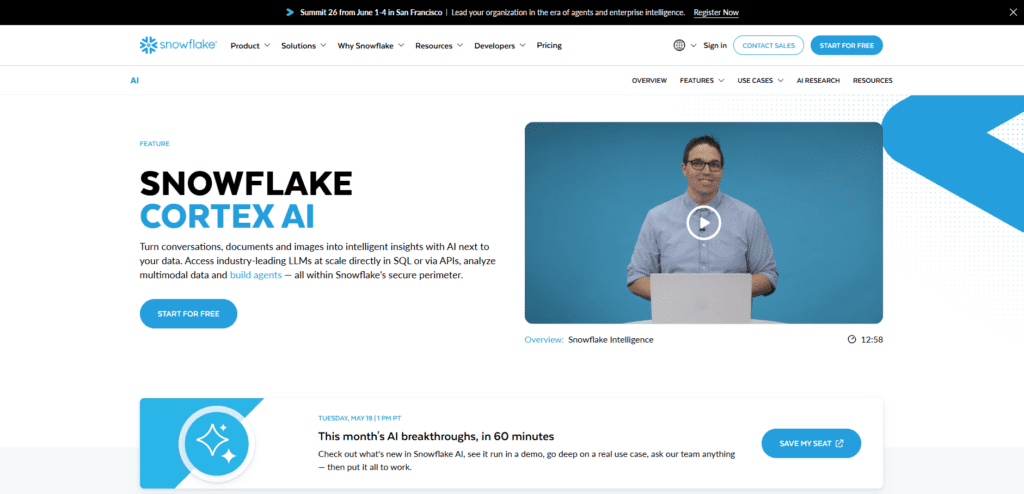
Snowflake Cortex AI solves one of the most persistent challenges in enterprise AI: getting intelligence closer to your data without moving the data itself.
Cortex AI brings large language models, vector search, text-to-SQL, and AI agents directly inside your data warehouse. It supports multiple models — including Anthropic and Meta — within a secure, governed environment. This eliminates the need to build complex data pipelines just to power AI features, reducing both cost and risk.
For organisations already on Snowflake, Cortex AI is a natural evolution. For analytics-driven companies exploring conversational AI enterprise use cases, it is one of the fastest paths to production-ready AI without rebuilding infrastructure.
Best for: Snowflake-native organisations, analytics-driven AI, data governance-sensitive environments.
Link: https://www.snowflake.com/en/data-cloud/cortex
9. UiPath
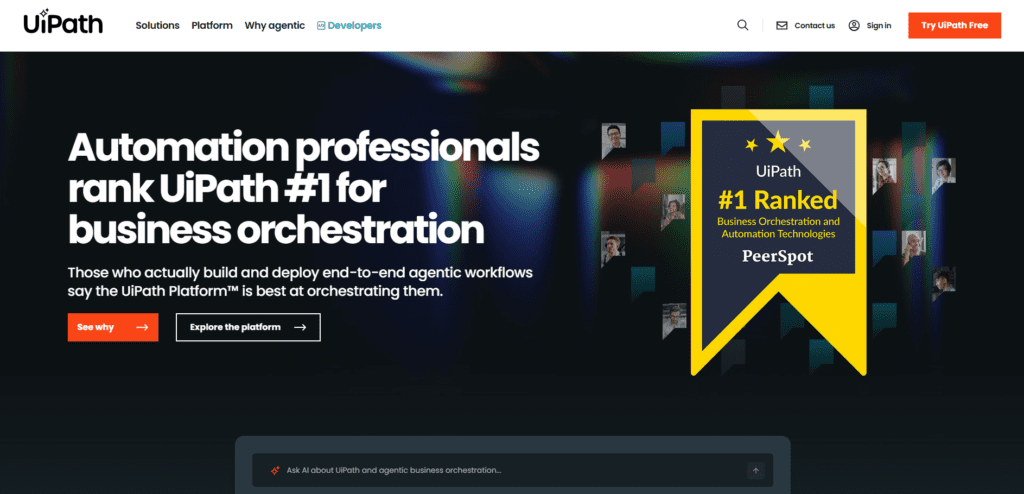
UiPath began as the world’s leading robotic process automation platform — and has evolved into a comprehensive intelligent automation powerhouse.
Today, UiPath combines AI agents, process mining, and automation across legacy systems and modern applications at scale. For enterprises with complex, high-volume operational workflows — particularly in compliance-heavy industries — UiPath delivers unmatched depth in attended and unattended automation.
What distinguishes UiPath in 2026 is its ability to bridge the gap between old infrastructure and new AI capabilities. If your organisation runs on legacy systems that can’t easily connect to modern AI platforms, UiPath is often the practical path forward.
Best for: Large-scale operational automation, legacy system integration, compliance-heavy industries.
Link: https://www.uipath.com
10. Kore.ai
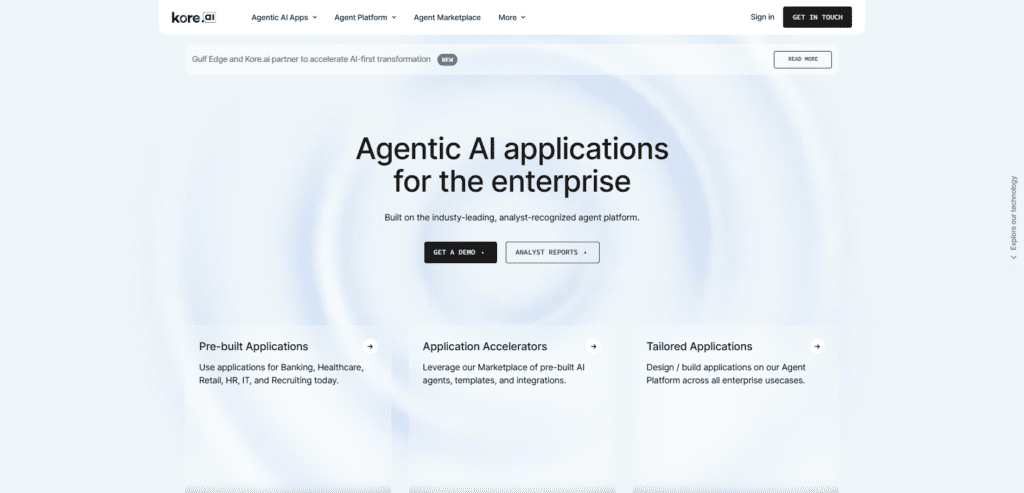
Kore.ai has built one of the most specialised and operationally mature platforms in the enterprise conversational AI space.
Focused on customer experience and employee experience, Kore.ai offers multi-agent orchestration, no-code and pro-code development options, a large marketplace of pre-built agents, and over 250 integrations. Its governance framework is robust enough for enterprise-scale deployments where accountability and auditability matter.
For organisations operationalising AI agents in contact centres or enterprise service environments, Kore.ai is among the most capable and fastest-to-deploy platforms available. Its strength lies not just in building agents — but in running them reliably at scale.
Best for: Contact centres, customer experience automation, employee experience, agent-at-scale deployments.
Link: https://kore.ai
How to Choose the Right Enterprise AI Platform
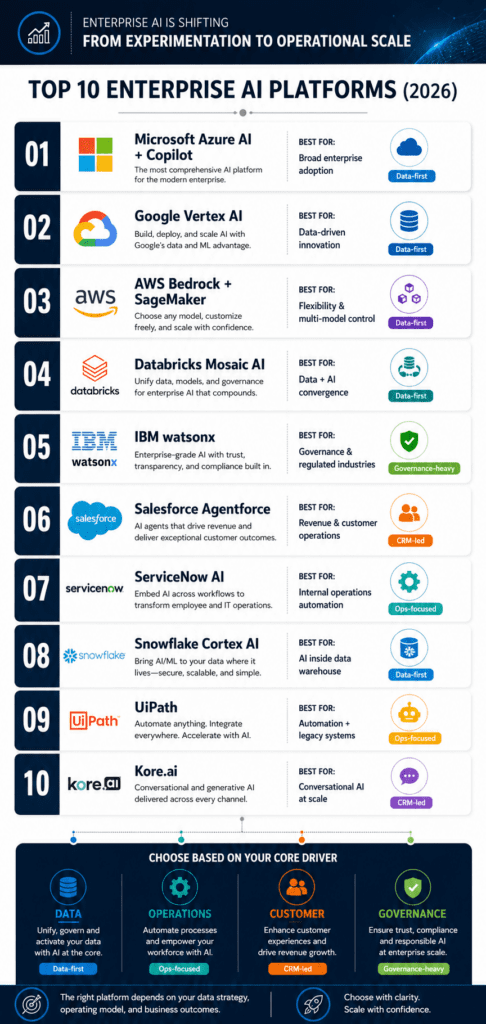
With ten strong options on the table, the selection decision comes down to four executive-level questions.
Where does your data live? If you’re deep in the Microsoft ecosystem, Azure and Copilot are your natural starting point. If your competitive advantage is in a data lakehouse, Databricks is the answer. Platform decisions should follow data architecture, not the other way around.
What problem are you solving first? Customer-facing automation points to Salesforce or Kore.ai. Internal operations and IT efficiency point to ServiceNow. Regulated compliance environments point to IBM watsonx. Match platform strength to your most urgent business priority.
How much flexibility do you need? AWS Bedrock offers unmatched model choice and infrastructure control. Google Vertex AI offers the most innovation headroom. For organisations that want to stay flexible as the AI landscape evolves, multi-model platforms are the safer long-term bet.
What does your governance requirement look like? Every regulated industry executive should treat governance as a non-negotiable filter — not an afterthought. IBM watsonx and Microsoft lead here, but every platform on this list has made significant governance investments in 2026.
What Most Enterprises Get Wrong
Most companies fail not because they pick the incorrect platform, but rather because they approach enterprise AI with the totally wrong attitude.
- Chasing technology rather than results. Organizations become enthralled with demos and features, implementing AI without connecting it to a clear, quantifiable business issue. The end product is costly pilots that never scale.
- Not investing enough in governance from day one. Governance is usually seen as a compliance checkbox rather than a strategic basis. This generates major legal and reputational risk down the road especially in regulated enterprises.
- Forgetting data preparedness. No matter how advanced an artificial intelligence platform is, it cannot make up for fractured, unmanaged, or poor-quality data. Enterprises that neglect data architecture work before platforms selection invariably perform below average.
- Ignoring change management. Without staff adoption, even the greatest platform in the world falls short. Executives spend a lot of money on technology but consistently ignore training, support, and cultural change.
- Attempting to boil the whole ocean. Trying to implement AI across every function at once strains resources and yields subpar outcomes everywhere instead of transformative outcomes anywhere.
The recipe for success is straightforward: start with your top business priority, match your platform to your data architecture, apply strict governance, and grow what is effective. Every time, ambition loses to discipline.
The Bottom Line for Enterprise Leaders
The enterprise AI software landscape in 2026 is mature, competitive, and consequential. The platforms listed here are not experiments — they are production-grade systems being used by the world’s largest organisations to drive measurable business outcomes.
The executives who will win are not the ones who wait for the “perfect” platform. They are the ones who align platform choice with business strategy, invest in governance from day one, and build an organisation-wide culture of AI adoption.
Every quarter you delay is a quarter your competitors gain ground. Pick your platform. Build your roadmap. Move with intention.
The enterprise AI race has already started. The only question left is whether you are leading it — or chasing it.