
We didn’t just cross a threshold in 2026 — we blew the door clean off its hinges.
For years, artificial intelligence felt like a technology that was always “almost there.” Impressive in demos, promising in headlines, but somehow still one step removed from genuinely changing everyday life. Then 2026 arrived — and everything shifted.
In just the first few months of this year, AI has gone from a smart assistant that helps you write emails to an autonomous force reshaping industries, redefining the workplace, and — quite literally — walking around in the physical world. The breakthroughs happening right now aren’t just technical upgrades. They represent a fundamental change in what AI is and what it does.
But it’s not all smooth sailing. Alongside the excitement come real questions about trust, safety, jobs, and who exactly benefits from all this progress. So let’s take an honest, eyes-wide-open look at the biggest AI developments of 2026 so far — the good, the complicated, and the genuinely extraordinary.
1. AI Has Stopped Waiting to Be Asked — The Rise of Agentic AI
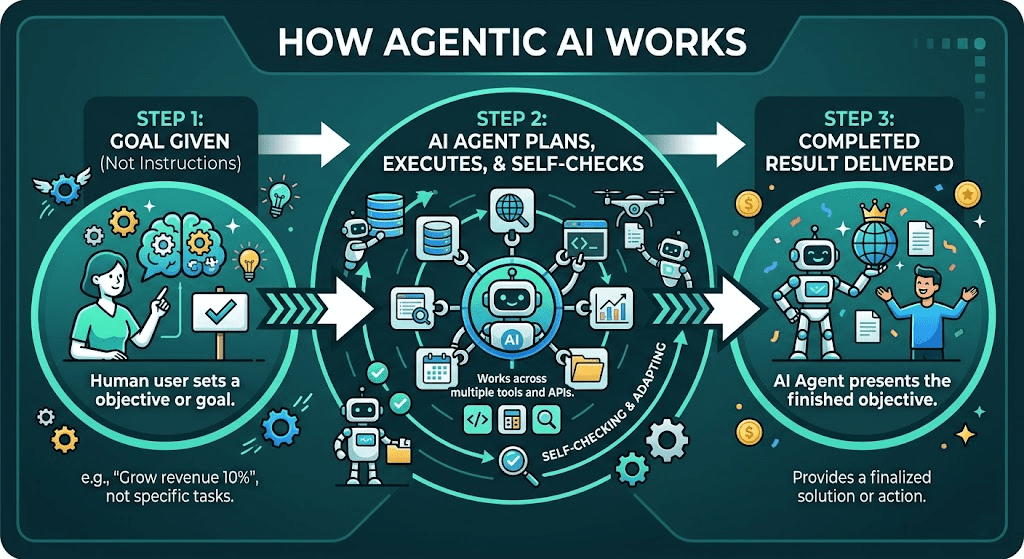
The big story of 2026 is the rise of agentic AI — artificial intelligence systems that act on your behalf instead of merely answering questions.
Consider it this way: older AI was like an extremely intelligent encyclopaedia. You enquired, it responded. Agentic AI is more like employing a competent intern who can log into your systems, carry out multi-step tasks, make judgments as they go, and report back once the job is finished, all without you looking over their shoulder.
In finance, logistics, software development, and customer relationship management, these artificial intelligence agents are now managing end-to-end procedures. They may schedule meetings, look at financial reports, fix code, and update databases all by themselves, constantly, and at scale.
Three key technological advancements made this feasible: long-term memory (agents now recall context across sessions), wider context windows (they can process significantly more information at once), and self-verification (they can examine their own output to identify mistakes before they escalate). Forrester and other businesses are already highlighting agentic AI as one of the main engines of real corporate ROI in 2026.
The Catch? When artificial intelligence operates on its own, errors could compound. An agent who misreads an instruction does more than simply provide you with the incorrect response; it could send the wrong email to a thousand consumers or carry out an unplanned financial transaction. As these systems become more effective, governance frameworks and human-in-the-loop checkpoints become increasingly vital.
2. The Model Wars Grow Up — Specialization Over Raw Power
While 2023 and 2024 centered on which AI model might be the most powerful and adaptable, 2026 is about which model excels at what matters to you.
Major AI labs have kept a fast rate of model upgrades. Leading the way in flexible, agentic workflows is OpenAI’s GPT-5 series, fantastic all-arounders that can manage a broad spectrum of challenging jobs. With remarkable results on SWE-bench, a challenging test for software engineering tasks, Anthropic’s Claude Opus 4.7 has become the go-to model for coding and advanced analysis. Google’s Gemini 3.1 Pro stands out for its multimodal reasoning capabilities, meaning it can process text, images, audio, and video together, and for its top performance in scientific reasoning benchmarks.
The open-source community, for one, is generating quite a commotion. DeepSeek V4, which has a trillion parameters (parameters are the units of knowledge within an AI model), is achieving comparable performance at a significantly lower cost than proprietary systems. This is making strong AI available to more people, but it’s also raising worries about safety supervision because open-source models are more difficult to control.
What should you learn from this? The one model dominating them all An era is passing. In its place: a specialized ecosystem where the best AI for your needs depends entirely on what you’re actually trying to do.
3. AI Steps Into the Real World — Robots, Embodiment, and Physical AI
Perhaps the most visually stunning change of 2026 is artificial intelligence leaving displays and servers for the actual world.
From science fiction display to production-grade reality, humanoid robots are machines with human-like bodies able to operate in actual settings. Companies showed robots at events such as CES 2026 that can handle manufacturing duties, help in the service industries, and adjust in real time to unexpected events. The AI brains driving these devices are the same multimodal models pushing digital world advancement, now used to vision, movement, and physical decision-making.
Researchers refer to this as embodied artificial intelligence, intelligence that interacts with and exists in the physical environment instead of only in data. The ramifications affect every sector: warehouses operating with little human labor, care robots supporting older people, and autonomous systems managing hazardous operations in building or disaster response.
AI companions, software-based systems meant for emotional connection and constant interaction, are becoming more advanced and realistic. This raises quite difficult ethical questions regarding attachment, control, and what it implies to create a relationship with a non-human intelligence. The potential is very high. Thus is the accountability.
4. The Infrastructure Arms Race — Chips, Data Centers, and Quantum Leaps
None of these artificial intelligence advances occurs in isolation. Behind every amazing model and every autonomous agent is an astounding amount of computing power, and in 2026, the battle to develop and possess such infrastructure has grown fiercely.
Anticipated investments in AI infrastructure this year worldwide are around $700 billion, supporting hyperscale data centers and next-generation chip designs. Companies are creating AI-specific processors that are quicker, more power-efficient, and purpose-built for the mathematical computations that AI models depend on.
The most thrilling area? Quantum computers. Although still in their early phases, advances such Microsoft’s Majorana 1 topological qubits signify meaningful advancement towards error-corrected quantum systems, which are machines that might one day address challenges in drug discovery, materials research, and climate modeling that would take classical computers thousands of years. IBM is looking at actual quantum advantage milestones that might come faster than most people expect.
There’s also a parallel push toward smaller, smarter models that can run on everyday devices rather than requiring massive cloud infrastructure. Driven by privacy issues and the practical necessity for AI that operates everywhere, on-device AI—processing occurring on your phone or laptop free from sending data to a distant server—is expanding quickly. The energy needs of all this technology are no little concern either, prompting significant debate over nuclear power, renewable energy, and the environmental impact of intelligence at scale.
5. Domain Breakthroughs — Healthcare, Coding, and Scientific Discovery
Although the headlines concentrate on significant model releases and robotic demonstrations, some of the most meaningful AI advancements in 2026 are occurring silently within particular sectors.
AI is acting in healthcare as a diagnostic partner by examining scans, highlighting abnormalities, and responding to patient inquiries at a level no human team could equal. Every day, AI copilots answer millions of health-related inquiries, guiding individuals in understanding symptoms, prescriptions, and treatment alternatives. Important difference: AI in medicine is most effective as a tool for physicians, not as a replacement for human clinical judgment.
Generative coding tools have drastically altered the way software is produced in software development. Developers are now outlining their wishes in simple language, and artificial intelligence takes care of a great deal of the actual code writing, testing, and debugging process. AI is devouring. With complete development processes being reorganized around AI cooperation, software has become a real industry maxim. Junior developers are increasingly being asked to transition from coding to evaluating and guiding AI-generated code, a skill set that differs considerably from conventional programming.
AI is accelerating discovery in scientific research in ways that are difficult to exaggerate. AI systems are discovering patterns and producing hypotheses more quickly than human investigators working alone, hence affecting everything from protein structure prediction to materials science to climate modeling. Mechanistic interpretability, the study of deciphering the reasoning behind AI models’ outputs by peeking inside the black box, is also seeing increasing investment.
6. The Bigger Picture — Promise, Risks, and the Road Ahead
For artificial intelligence, 2026 has been dubbed the Year of Truth, the point at which the technology must validate its significant investment with concrete, quantifiable outcomes. By several criteria, it is delivering. It is becoming possible to measure gains in productivity. Scientific breakthroughs are increasing in speed. AI is giving companies real returns on their investment.
However, the difficulties are just as serious. As agentic artificial intelligence assumes jobs previously held by knowledge employees, worries about job displacement is rising. Geopolitical tensions over AI sovereignty—countries creating separate AI stacks, vying for talent, and striving for technological supremacy—are changing global relations. Furthermore, pressing and mostly unanswered are issues of AI safety, interpretation, and governance.
Some experts caution about an artificial intelligence boom, a turning point at which inflated expectations collide with the reality of deployment difficulties. Others believe that AI will increase productivity throughout the economy, therefore potentially lowering costs in everything from software to healthcare to logistics, resulting in a deflationary wave.
We are living through one of the most consequential technological transitions in human history — and unlike previous industrial revolutions, this one is moving at software speed.
The AI breakthroughs of 2026 — autonomous agents, specialized frontier models, physical AI, quantum infrastructure, and domain-specific revolutions — are not isolated developments. They are pieces of a much larger shift in how intelligence itself is created, distributed, and used. The opportunities are extraordinary. The stakes are equally high.
The best thing any curious person can do right now is stay informed, think critically, and resist the twin temptations of pure hype and pure fear. The future of AI isn’t being written by algorithms alone — it’s being shaped by the choices we make as individuals, organizations, and societies about how to build, deploy, and govern these systems.
And if 2026 is any indication, those choices are coming faster than any of us expected.